Using AI to make critical flood forecasting information universally accessible
Every year, floods cause thousands of fatalities worldwide, disrupt the lives of millions, and cause significant financial damages. To ensure that no one is surprised by these natural disasters and to help communities better prepare, Google Research has developed AI models to forecast riverine floods and flash floods in urban areas. Our state-of-the-art models deliver accurate, timely information, empowering governments and organizations to respond to crises, and helping communities stay safe and informed. After years of research and development, our technology is now scalable and covers more than 150 countries. Our flood models are part of the Google Earth AI collection of models and datasets for planetary intelligence, and we continue to expand these capabilities and coverage.
Flood Hub
Flood Hub is a visual resource that displays flood maps, water trends and real-time flood forecasts based on our AI models and global data sources. Flood Hub is designed to meet the needs of governments, local aid organizations, and communities directly at risk. With forecasts up to 7 days in advance for riverine floods and up to 24 hours in advance for urban flash floods, users are able to assess the situation to take timely action. All information in Flood Hub is free of charge, publicly available, and can be shared over social networks. Forecasts are updated daily.
These AI-powered forecasts cover 2B people in over 150 countries, in areas at risk for significant flood events.
We also provide researchers and experts with additional data — via an API, the open-sourced hydrology model, the Google Runoff Reanalysis & Reforecast (GRRR) dataset and the inundation dataset.
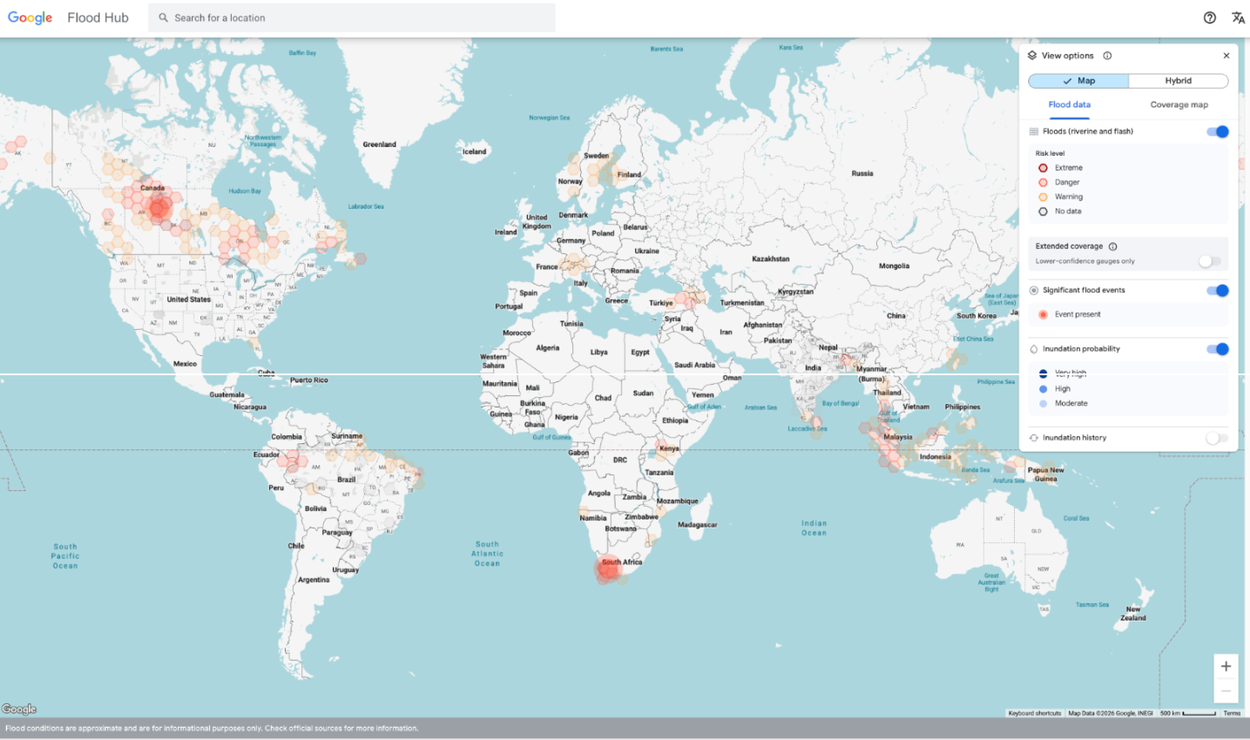
Flood Hub currently covers river basins in 150+ countries.
Alerts and notifications
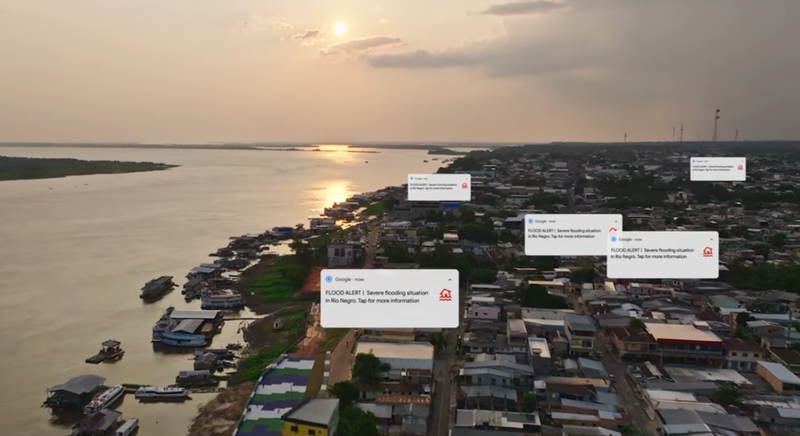
In many countries, we also share our forecasts through Google Search, Google Maps, and via Android notifications to help more people access flood information.
Research breakthrough: Predicting riverine floods globally
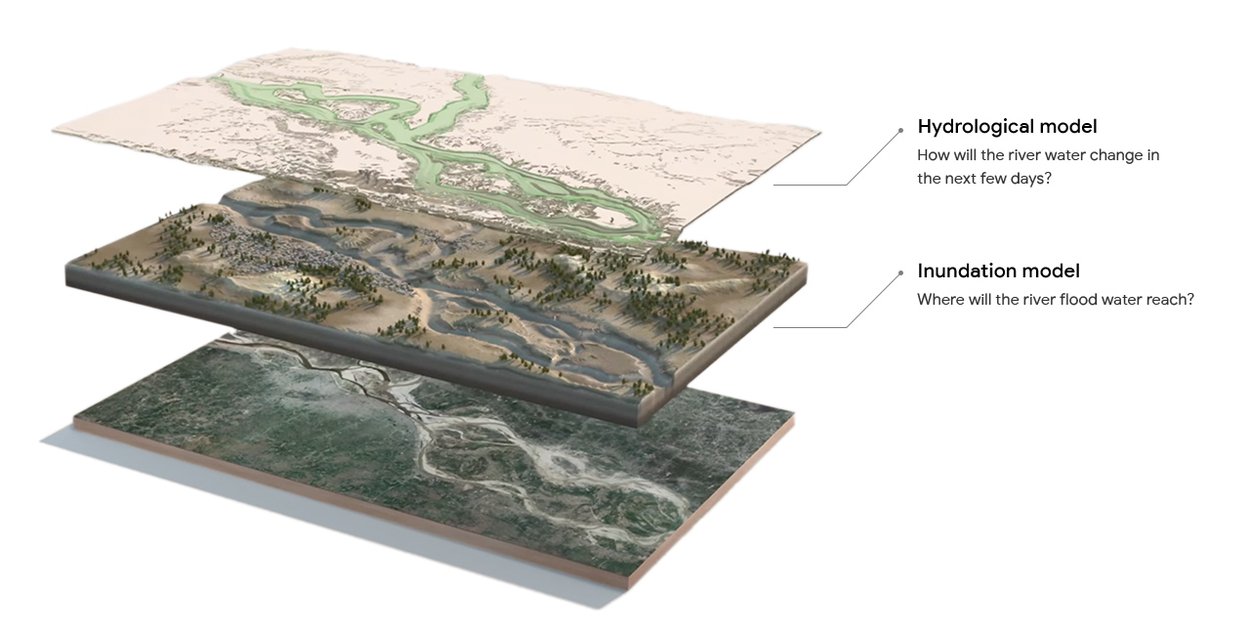
Our system combines two AI models that process diverse publicly available data sources: a global hydrology model, published in Nature, to forecast the amount of water flowing in a river, and an inundation model that predicts affected areas and how high the water level will be.
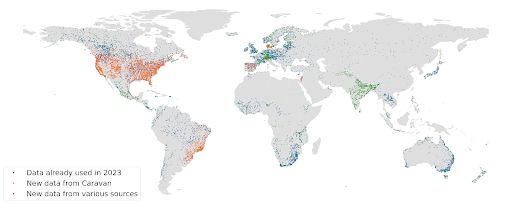
Our models are trained on a wide variety of publicly available global weather products, river gauge measurements and satellite imagery to provide reliable forecasts even in regions that previously lacked data. These forecasts are more actionable and accurate than the state-of-the-art, widely-used globally-available GloFAS model.
Research breakthrough: Predicting flash floods with 24 hour notice
Robust historical “ground truth” data did not exist for flash floods due to their rapid onset. Without a historical record of exactly where and when these events occurred, traditional supervised ML models cannot learn the patterns necessary to predict them.
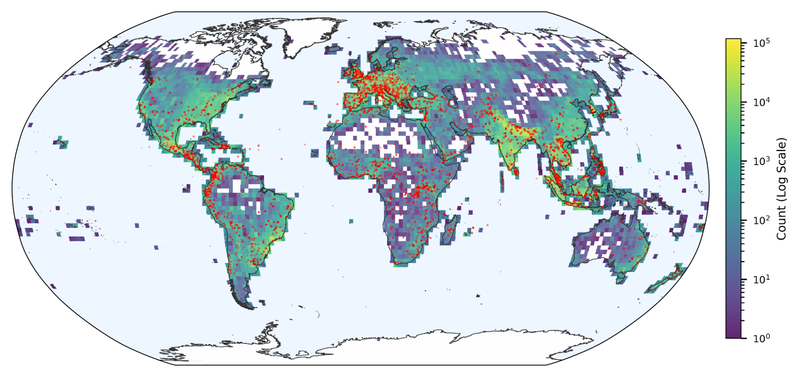
To address this, we developed Groundsource, a scalable methodology that leverages Gemini to transform unstructured global news into actionable, historical data. Our first, open-access Groundsource dataset for urban flash floods comprises 2.6 million records based on 20 years of news reports. We used this dataset to train the flash floods model, paving the way for more accurate, life-saving forecasts.
The flash flood forecasting model processes a historical 7-day hindcast sequence of meteorological (and geophysical) input data and a forecast for the next 24 hours with inputs from meteorological forecasts. The model predicts, at each time step the probability of a flash flood occurring in a specific urban region within the next 24 hours, with spatial resolution of 20km x 20km.
Real world impact
Discover how our advanced AI flood forecasting models and global partnerships are protecting communities, empowering local governments, and saving lives.


Discover more