Jump to Content

Neural mapping

Google Research is driving progress toward precisely mapping the connections between every cell in the brain.

play silent looping video pause silent looping video
unmute video mute video

What is connectomics?

The human brain is perhaps the most computationally complex machine in existence, consisting of networks of billions of cells. Researchers currently don’t understand the full picture of how glitches in its network machinery contribute to mental illnesses and other diseases, such as dementia. However, the emerging connectomics field, which aims to precisely map the connections between every cell in the brain, could help solve that problem.

Video preview image

Watch the film

The Connectomics team at Google Research has played a key role in advancing the connectonomics field by developing new technologies that have accelerated scientific progress. These technologies enabled us to map parts of the fruit fly, mouse and human brain, and could one day help us better understand how the human brain works and how to treat brain diseases. The timeline and chart below demonstrate how connectomics has evolved since the 1970s.

NeuralMapping_projects

Featured publications

Sexual dimorphism in the complete connectome of the Drosophila male central nervous system
Stuart Berg
Isabella R Beckett
Marta Costa
Philipp Schlegel
Elizabeth C Marin
Aljoscha Nern
Stephan Preibisch
Wei Qiu
Shin-ya Takemura
Andrew Champion
Reed A. George
Gary Huang
William Katz
Christopher Ordish
Ken Hayworth
Eric Trautman
Vivek Jayaraman
Wyatt Korff
Geoffrey W Meissner
Sandro Romani
Jan Funke
Christopher Knecht
Stephan Saalfeld
Louis Scheffer
Scott Waddell
Gwyneth Card
Carlos Ribeiro
Michael B. Reiser
Harald Hess
Gerry Rubin
Gregory S.X.E. Jefferis
bioRxiv (2026)
Preview abstract Sex differences in behaviour exist across all animals, typically under strong genetic regulation. In Drosophila, fruitless/doublesex transcription factors can identify dimorphic neurons but their organisation into functional circuits remains unclear. We present the connectome of the entire Drosophila male central nervous system. This contains 166,691 neurons spanning the brain and nerve cord, fully proofread and annotated including fruitless/doublesex expression and 11,691 types. We provide the first comprehensive comparison between male and female brain connectomes to synaptic resolution, finding 7,205 isomorphic, 114 dimorphic, 262 male-specific and 69 female-specific types. This resource enables analysis of full sensory-to-motor circuits underlying complex behaviours and the impact of dimorphic elements. Sex-specific/dimorphic neurons are concentrated in higher brain centres while the sensory and motor periphery are largely isomorphic. Within higher centres, male-specific connections are organised into hotspots defined by male-specific neurons or arbours. Numerous circuit switches reroute sensory information to form antagonistic circuits controlling opposing behaviours. (Full author list included with the paper.) View details
A petavoxel fragment of human cerebral cortex reconstructed at nanoscale resolution
Alex Shapson-Coe
Daniel R. Berger
Yuelong Wu
Richard L. Schalek
Shuohong Wang
Neha Karlupia
Sven Dorkenwald
Evelina Sjostedt
Dongil Lee
Luke Bailey
Angerica Fitzmaurice
Rohin Kar
Benjamin Field
Hank Wu
Julian Wagner-Carena
David Aley
Joanna Lau
Zudi Lin
Donglai Wei
Hanspeter Pfister
Adi Peleg
Jeff W. Lichtman
Science (2024)
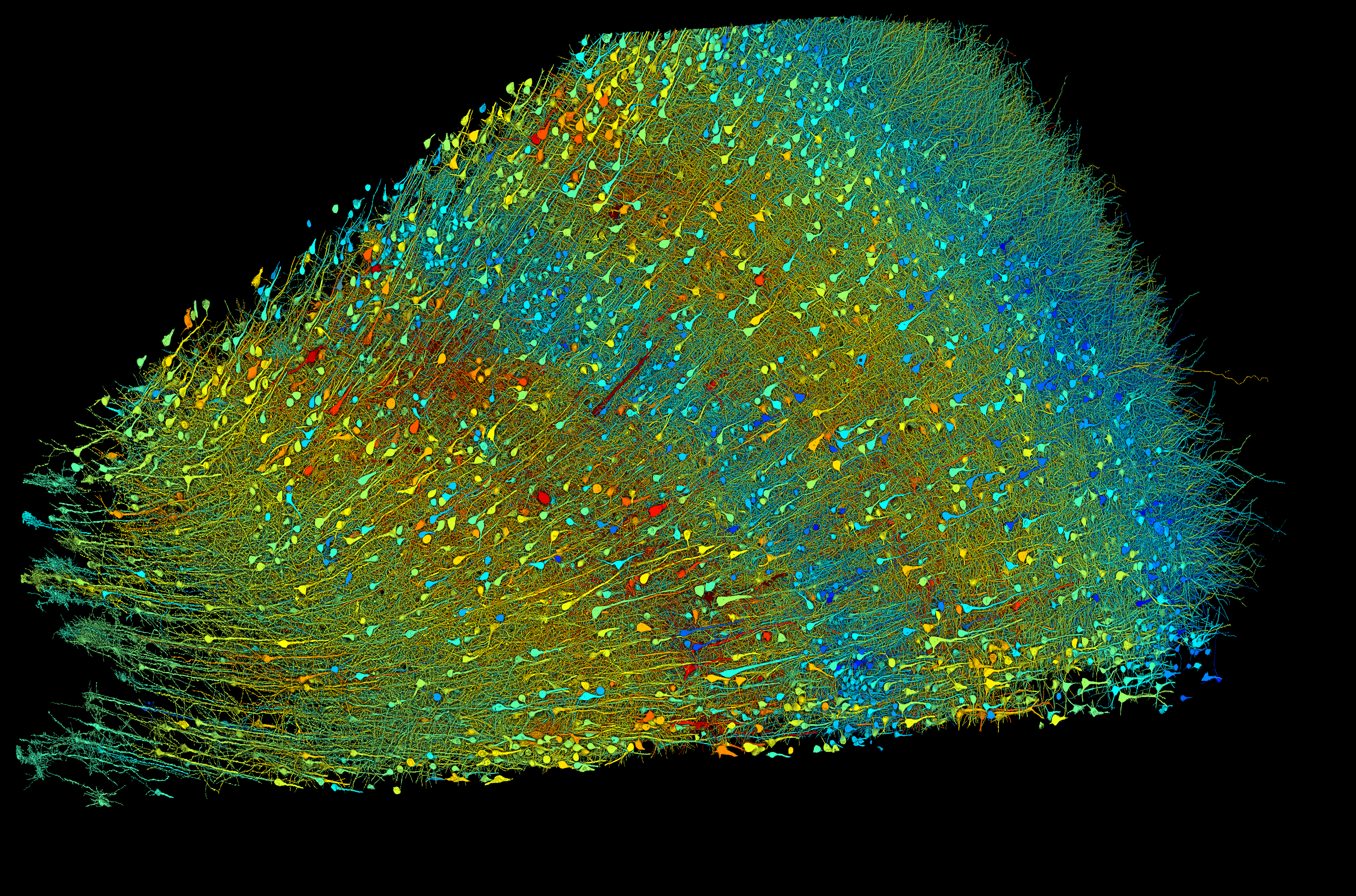
Preview abstract To fully understand how the human brain works, knowledge of its structure at high resolution is needed. Presented here is a computationally intensive reconstruction of the ultrastructure of a cubic millimeter of human temporal cortex that was surgically removed to gain access to an underlying epileptic focus. It contains about 57,000 cells, about 230 millimeters of blood vessels, and about 150 million synapses and comprises 1.4 petabytes. Our analysis showed that glia outnumber neurons 2:1, oligodendrocytes were the most common cell, deep layer excitatory neurons could be classified on the basis of dendritic orientation, and among thousands of weak connections to each neuron, there exist rare powerful axonal inputs of up to 50 synapses. Further studies using this resource may bring valuable insights into the mysteries of the human brain. View details
Light-microscopy-based dense connectomic reconstruction of mammalian brain tissue
Mojtaba R. Tavakoli
Julia Lyudchik
Vitali Vistunou
Nathalie Agudelo Duenas
Jakob Vorlaufer
Christoph Sommer
Caroline Kreuzinger
Barbara de Souza Oliveira
Alban Cenameri
Gaia Novarino
Johann Danzl
Nature (2025)
Preview abstract The information-processing capability of the brain’s cellular network depends on the physical wiring pattern between neurons and their molecular and functional characteristics. Charting neurons and resolving the individual synaptic connections requires volumetric imaging at nanoscale resolution and comprehensive cellular contrast. Light microscopy is uniquely positioned to visualize specific molecules but dense, synapse-level circuit reconstruction by light microscopy has been out of reach due to limitations in resolution, contrast, and volumetric imaging capability. Here we developed light-microscopy based connectomics (LICONN). We integrated hydrogel embedding and expansion with comprehensive deep-learning based segmentation and analysis of connectivity, thus directly incorporating molecular information in synapse-level brain tissue reconstructions. LICONN will allow synapse-level brain tissue phenotyping in biological experiments in a readily adoptable manner. View details
ZAPBench: a benchmark for whole-brain activity prediction in zebrafish
Alex Immer
Alex Bo-Yuan Chen
Mariela Petkova
Nirmala Iyer
Luuk Hesselink
Aparna Dev
Gudrun Ihrke
Woohyun Park
Alyson Petruncio
Aubrey Weigel
Wyatt Korff
Florian Engert
Jeff W. Lichtman
Misha Ahrens
International Conference on Learning Representations (ICLR) (2025)
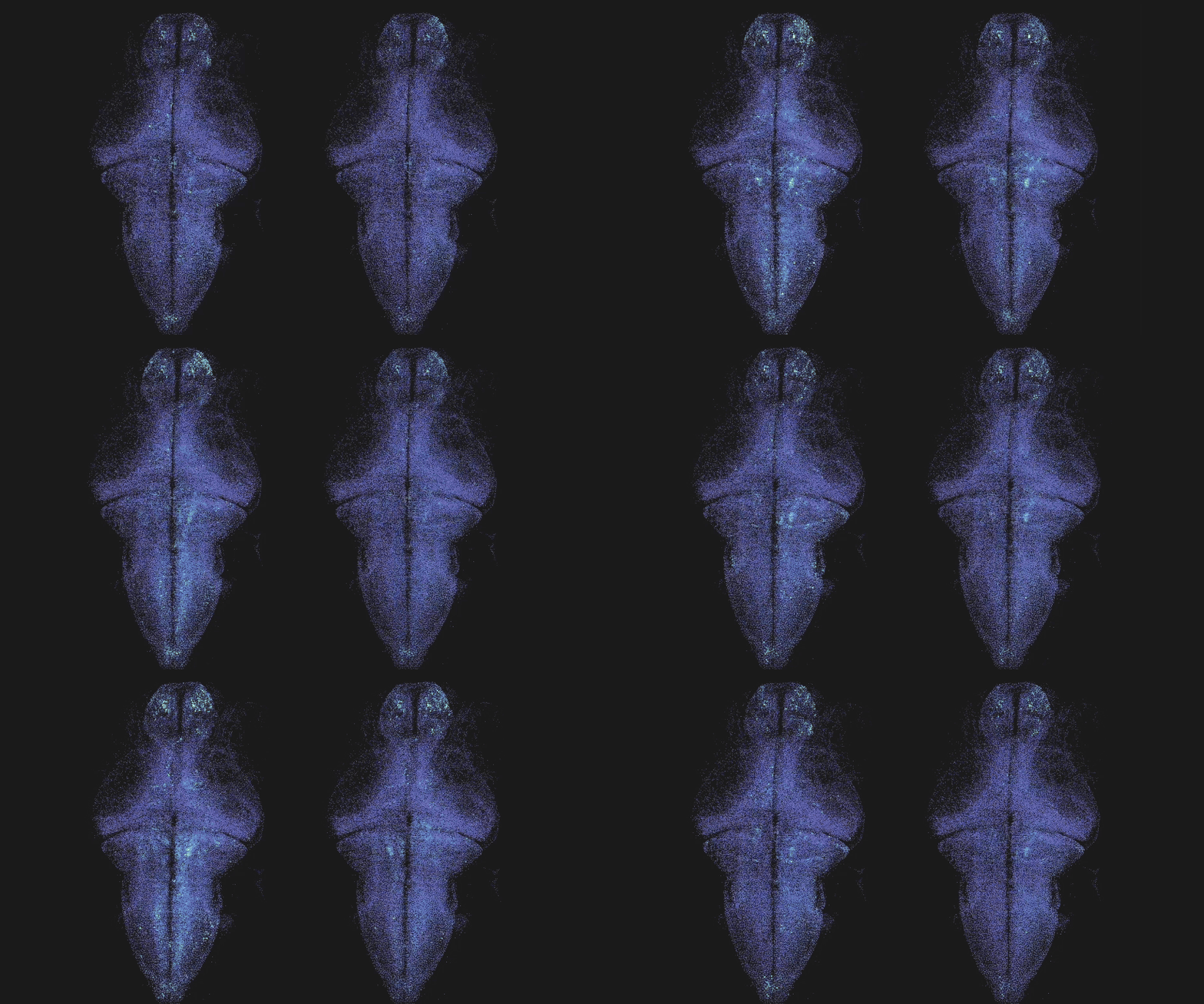
Preview abstract Data-driven benchmarks have led to significant progress in key scientific modeling domains including weather and structural biology. Here, we present the Zebrafish Activity Prediction Benchmark (ZAPBench), which quantitatively measures progress on the problem of predicting cellular-resolution neural activity throughout an entire vertebrate brain. The benchmark is based on a novel dataset containing 4d light-sheet microscopy recordings of more than 70,000 neurons in a larval zebrafish brain, along with motion stabilized and voxel-level cell segmentations of these data that facilitate development of a variety of forecasting methods. Initial results from a selection of time series and volumetric video modeling approaches achieve better performance than naive baseline methods, but also show room for further improvement. The specific brain used in the activity recording is also undergoing synaptic-level anatomical mapping, which will enable future integration of detailed structural information into ZAP forecasting methods. View details
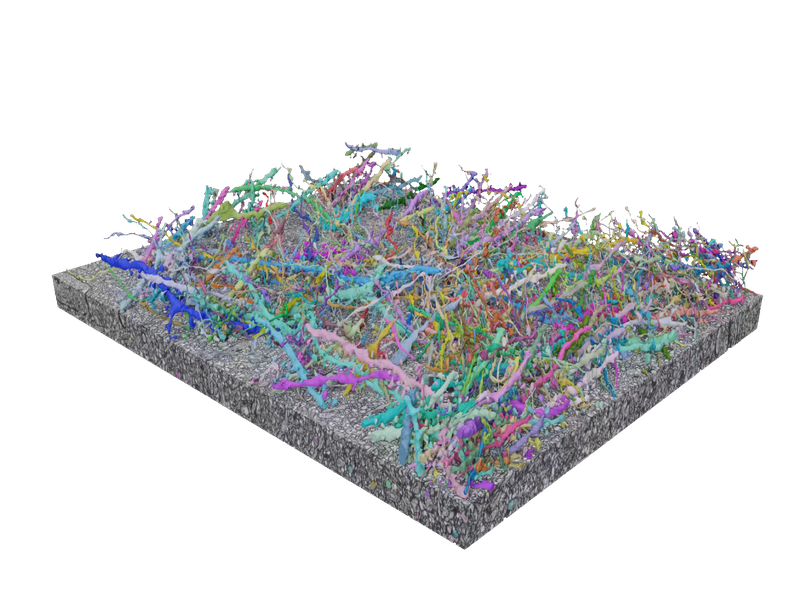
Preview abstract Biological neurons come in many shapes. High-fidelity generative modeling of their varied morphologies is challenging yet underexplored in neuroscience, and crucial for the subfield of connectomics. We introduce MoGen (Neuronal Morphology Generation), a flow matching model to generate high-resolution 3D point clouds of mouse cortex axon and dendrite fragments. This is enabled by an adaptation that injects local geometric context into a scalable latent transformer backbone, allowing for the generation of high-fidelity, realistic samples. To assess MoGen's generation quality, we propose a dedicated evaluation suite with interpretable geometric and topological features tailored to neuronal structures that we validate in a user study. MoGen's practical utility is showcased through controllable generation for visualization via smooth interpolation and a direct downstream application: we augment the training set of a shape plausibility classifier from a production connectomics neuron reconstruction pipeline with millions of generated samples, thereby improving classifier accuracy and reducing the number of remaining split and merge errors by 4.4%. We estimate this can reduce manual proofreading labor by over 157 person-years for reconstruction of a full mouse brain. View details
Automated synapse-level reconstruction of neural circuits in the larval zebrafish brain
Fabian Svara
Dominique Förster
Fumi Kubo
Marco dal Maschio
Philipp Schubert
Jörgen Kornfeld
Adrian Wanner
Winfried Denk
Herwig Baier
Nature Methods, 19 (2022), 1357–1366
Preview abstract Dense reconstruction of synaptic connectivity requires high-resolution electron microscopy images of entire brains and tools to efficiently trace neuronal wires across the volume. To generate such a resource, we sectioned and imaged a larval zebrafish brain by serial block-face electron microscopy at a voxel size of 14 × 14 × 25 nm3. We segmented the resulting dataset with the flood-filling network algorithm, automated the detection of chemical synapses and validated the results by comparisons to transmission electron microscopic images and light-microscopic reconstructions. Neurons and their connections are stored in the form of a queryable and expandable digital address book. We reconstructed a network of 208 neurons involved in visual motion processing, most of them located in the pretectum, which had been functionally characterized in the same specimen by two-photon calcium imaging. Moreover, we mapped all 407 presynaptic and postsynaptic partners of two superficial interneurons in the tectum. The resource developed here serves as a foundation for synaptic-resolution circuit analyses in the zebrafish nervous system. View details
Preview abstract Early machine-learning systems were inspired by neural networks — now AI might allow neuroscientists to get to grips with the brain’s unique complexities. View details
Preview abstract Reconstruction of neural circuits from volume electron microscopy data requires the tracing of cells in their entirety, including all their neurites. Automated approaches have been developed for tracing, but their error rates are too high to generate reliable circuit diagrams without extensive human proofreading. We present flood-filling networks, a method for automated segmentation that, similar to most previous efforts, uses convolutional neural networks, but contains in addition a recurrent pathway that allows the iterative optimization and extension of individual neuronal processes. We used flood-filling networks to trace neurons in a dataset obtained by serial block-face electron microscopy of a zebra finch brain. Using our method, we achieved a mean error-free neurite path length of 1.1 mm, and we observed only four mergers in a test set with a path length of 97 mm. The performance of flood-filling networks was an order of magnitude better than that of previous approaches applied to this dataset, although with substantially increased computational costs. View details
×
×